



Advantage+ App Campaigns (A+AC), formerly known as Automated App Ads (AAA), are Meta’s most automated campaign type for app installs. You supply the budget, the location and the creatives, and Meta’s system decides who sees the ads, where they run and which creative combinations get served. In this article, we will dive deeper into the benefits, challenges and possibilities of Advantage+ App Campaigns (A+AC) on Meta, including a breakdown of our own experiments.
Table of Contents
The short answer: A+AC saves setup work by handing audience, placement and creative decisions to Meta’s machine learning, but you give up most targeting control. For apps with a narrow audience, that broad delivery can waste budget. In one Admiral-managed campaign for a maternal health app aimed at women aged 24 to 38, 15.6% of the A+AC budget went to men, and A+AC did not deliver the 10% lower CPI we were testing for. Treat A+AC as one tool next to manual campaigns, and test it against them before you move budget.
What Advantage+ App Campaigns are and how they work
A+AC’s primary goal is to bolster the performance of your app campaigns by dramatically reducing manual effort. The power behind this is machine learning: according to Meta’s help page, Advantage+ app campaigns use Meta AI to help optimize bidding, audiences and placements, so the system decides which creatives reach which audience segments in which placements. Unlike their manual counterparts, A+AC demands minimal input during creation, simplifying choices related to audience targeting and the entire creative management ordeal. Furthermore, they’ve expanded their horizons by incorporating options to optimize app installs in tandem with app events, all under a singular campaign. In short, Advantage+ app campaigns are designed to maximize the performance of your app install campaigns with less effort. The less effort part comes from fewer inputs: Meta lets you upload up to 50 images or videos at once and builds the ads for you, so you no longer duplicate ads by hand for every audience, placement and creative test. The performance part depends on how well Meta’s broad delivery fits your real audience, which is exactly what our test below looks at.
Before diving deeper into A+AC, you must understand ‘Liquidity’
To get the most out of A+AC, you must first understand liquidity. It essentially covers four aspects of your campaigns where you can increase liquidity:
- Budget
- Placement
- Audience
- Creative
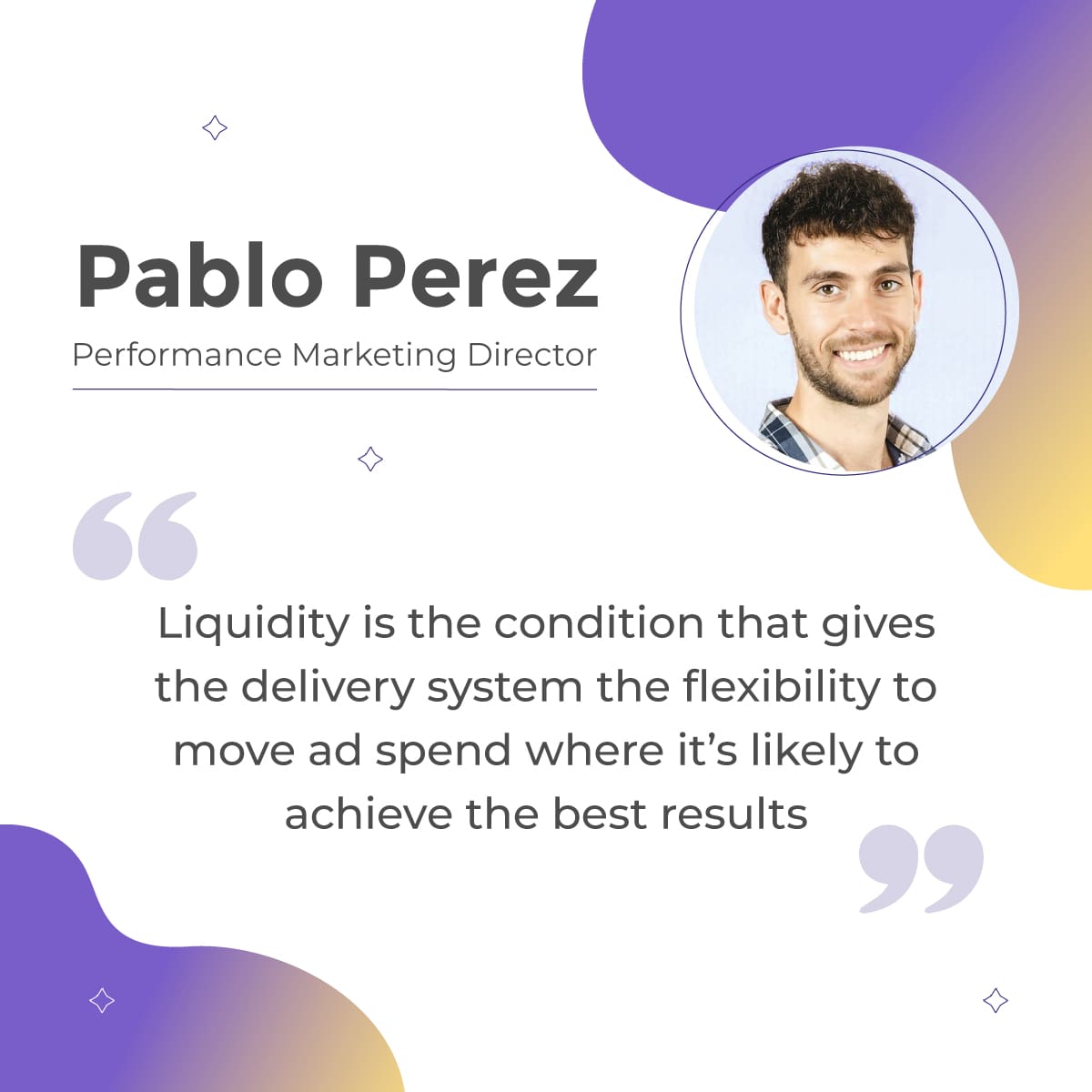
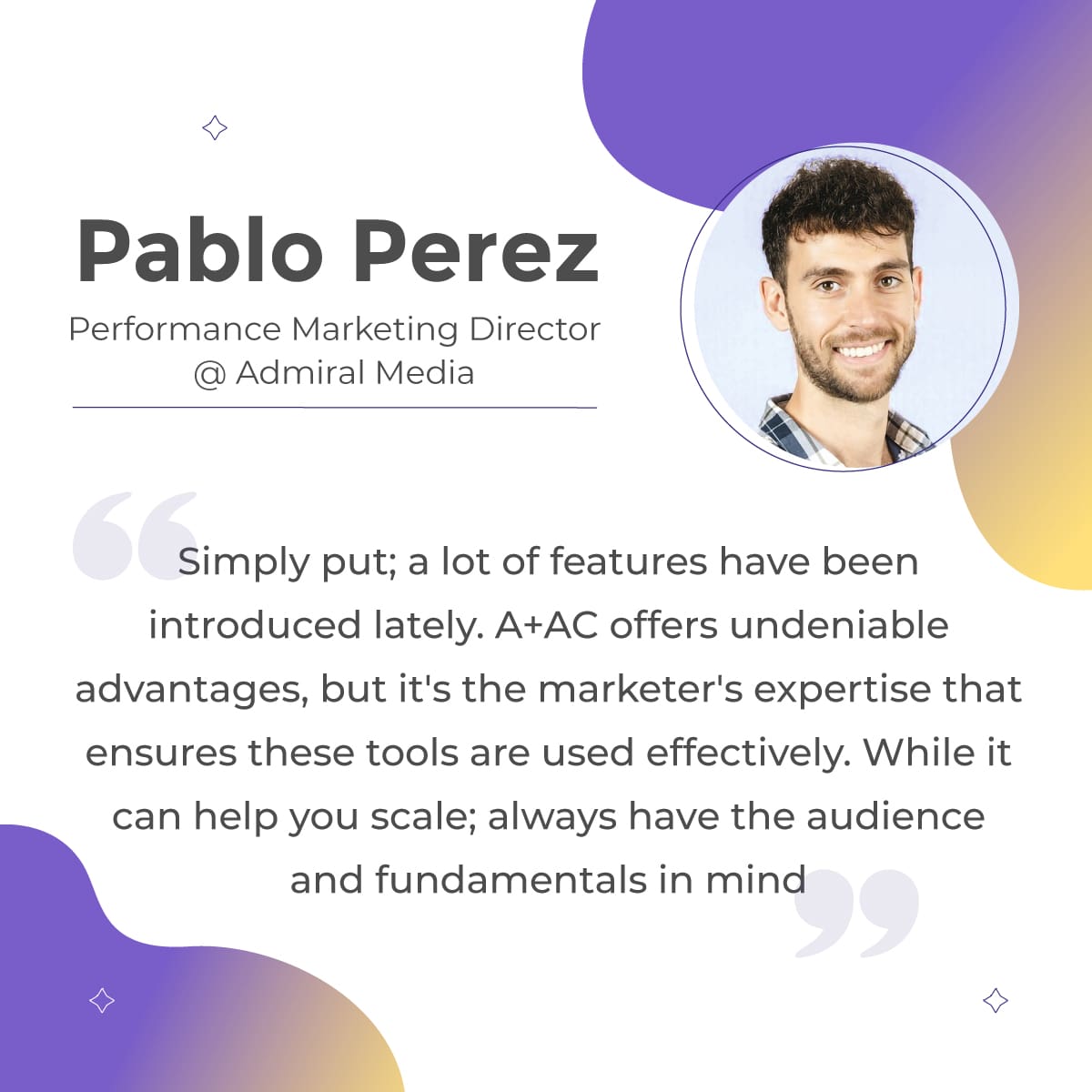
Liquidity, as our expert Pablo Perez puts it in the quote above, is the condition that gives the machine learning the flexibility to move ad spend where it’s likely to achieve the best results. Liquidity can be increased in your campaigns by setting broader parameters (fewer restrictions). Meta’s own help page on placements shows the idea: its delivery system aims for the most results at the lowest average cost across all placements combined, and in Meta’s worked example, switching off Instagram cut results from 9 to 8 while the average cost per result rose from $3 to $3.25. By using A+AC, you enable the system to maximize its liquidity, which in theory will provide enhanced performance. But… is broader always better and more efficient? We will discuss this, later in this article. Before we do so, let’s quickly touch upon the advantages and disadvantages of A+AC.
What are the advantages of Advantage+ App Campaigns?
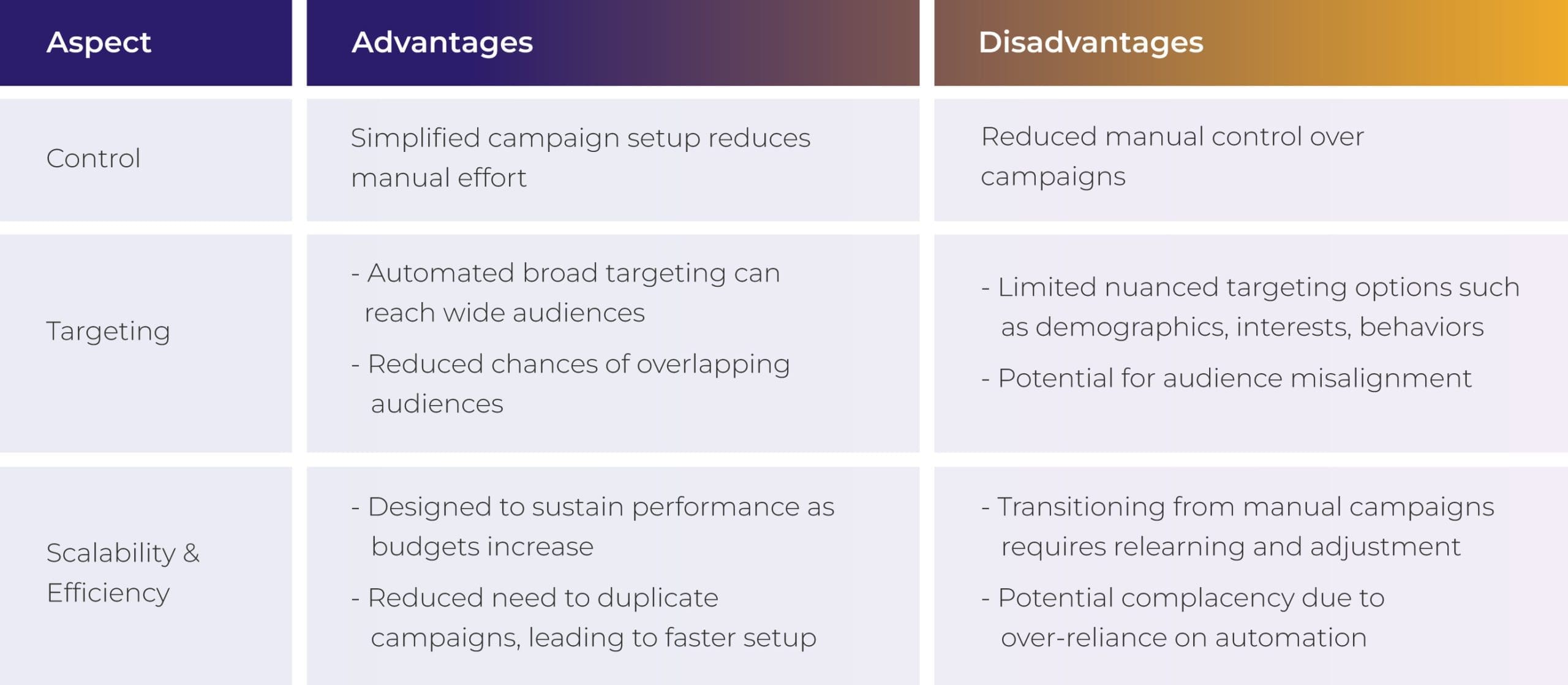
With the introduction of A+AC, we have been presented with a tool that promises to reduce manual workload and increase the efficiency of ad campaigns. The workload drops because one campaign replaces the separate ad sets you would otherwise build per audience, placement and creative test. The efficiency claim rests on liquidity: with fewer restrictions, Meta can move spend to wherever results are cheapest at that moment.
Automated Efficiency with Machine Learning:
- A+AC leverages machine learning to automate many facets of the campaign process. This ensures ads are optimized in real-time, adjusting to user behaviors and preferences.
Optimal Placement for Better Engagement:
- A+AC automatically selects the best platforms and placements for your ads based on where they’re most likely to be effective. This increases the chances of your ad being seen by the right eyes at the right time.
Scalability:
- Meta says A+AC is built so that app campaigns scale efficiently. The reasoning is that broad audiences and automatic placements give the system more room to find extra installs as the budget grows. That is a promise, not a guarantee: performance can still drop as you scale, and in our own work we have seen greater efficiency when using manual campaigns compared to A+AC.
Simplified Campaign Creation:
- The streamlined process requires fewer inputs from us, advertisers, which can be particularly beneficial for those managing multiple campaigns.
Dynamic Creative Testing and Delivery:
- The platform doesn’t just set and forget. It continuously tests different creative combinations, ensuring the most effective ads are showcased to the target audience. This dynamic approach can lead to better engagement and conversion rates.
Reduced Audience Overlap:
- The structure of A+AC minimizes the chance of overlapping target audiences, ensuring campaigns are more distinct and thereby potentially increasing the efficiency of each campaign.
What are the disadvantages of Advantage+ App Campaigns?
As with every pro, there’s a con. It is our duty to provide insights and share our knowledge with our readers – and not just simply follow the best practices. Advantage+ App Campaigns (A+AC) offer real benefits, mainly less setup work and more freedom for Meta’s delivery system to find cheaper installs, but they are not devoid of potential downsides. Understanding these limitations is crucial for marketers to make informed decisions about when and how to leverage A+AC in their strategies. Here’s a detailed look at some of the disadvantages:
Reduced Manual Control:
- One of the most notable disadvantages of A+AC is the relinquishment of control. By automating many processes, we (the advertisers), give up granular control over campaign specifics, which might not sit well with those accustomed to meticulous, manual adjustments.
Potential Over-reliance on Automation:
- While automation is beneficial, over-relying on it can make marketers complacent. The dynamic nature of the digital ad landscape requires human intuition and insight, which cannot be entirely replaced by algorithms.
Limitations in Targeting Options:
- A+AC has certain restrictions on more nuanced targeting features. The inability to utilize demographics, interests, behaviors, and certain custom audience features can be limiting for campaigns requiring very specific targeting. Meta’s help page lists gender, demographics, interests, behaviors, custom audience inclusions and lookalike audiences as unsupported. You can still set country, language and operating system, plus an account-wide minimum age and custom audience exclusions in your ad account settings.
Potential for Audience Misalignment:
- While A+AC attempts to reduce audience overlap, its broad targeting approach might not always align perfectly with your ideal audience, leading to less-than-optimal results and budget wasted.
Transition Challenges:
- For businesses transitioning from manual campaigns to A+AC, there’s a learning curve. Existing strategies might not translate directly, requiring teams to relearn and adjust.
Table: The advantages and disadvantages of Advantage+ App Campaigns on Meta
Experimenting with Advantage+ App Campaigns
In the following case, we experimented with an Advantage+ App Campaign, for our client. Before showing you the insights, here’s some useful information about the client:
- Client info: A digital companion app for mothers with resources designed by maternity specialists that include self-knowledge programs to keep track of your maternal health
- Target audience: Women between the ages of 24-38
Upon experimenting with the A+AC, we had a hypothesis that by using this campaign type, we would achieve lower CPIs and Cost pr. Registrations, as it would enable maximum liquidity. The experiment was set to run for 7 days, and the success criteria were to at least lower the CPI by 10%.
Here is the breakdown of the gender, for the Advantage+ App Campaign:
In this campaign, which Admiral managed for the client, the delivery data (chart below) showed that 15.6% of the budget was allocated towards males. The client does not offer any features or services related to this audience. A quick learning we gathered here, was that the lack of targeting control can be harmful for brands that are focused on specific (and narrow) target audiences. 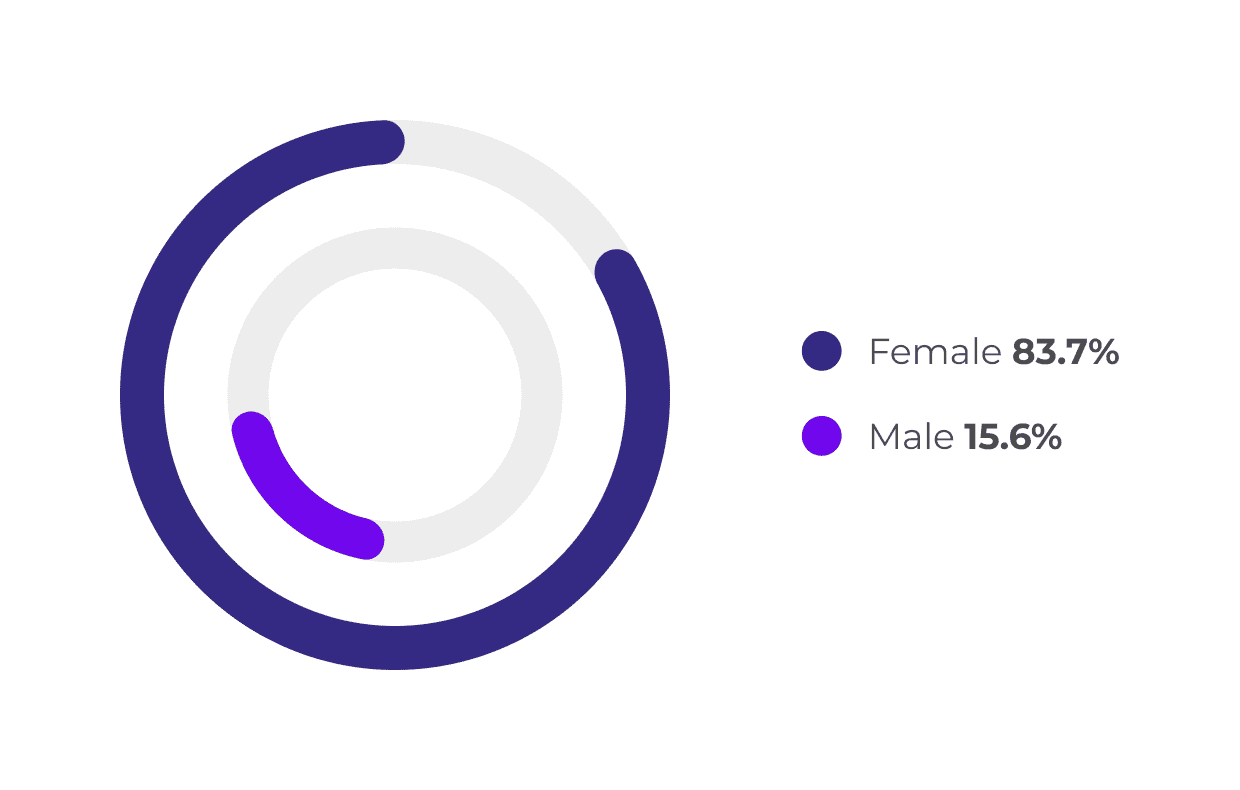
Here is the breakdown of the age groups, for the Advantage+ App Campaign:
Breaking down the data into granular pieces, we noticed that a quite big proportion of the spent was used on irrelevant age groups for our client. Yes, the algorithm is very smart – but be very careful, because it can indeed result in wasted money. 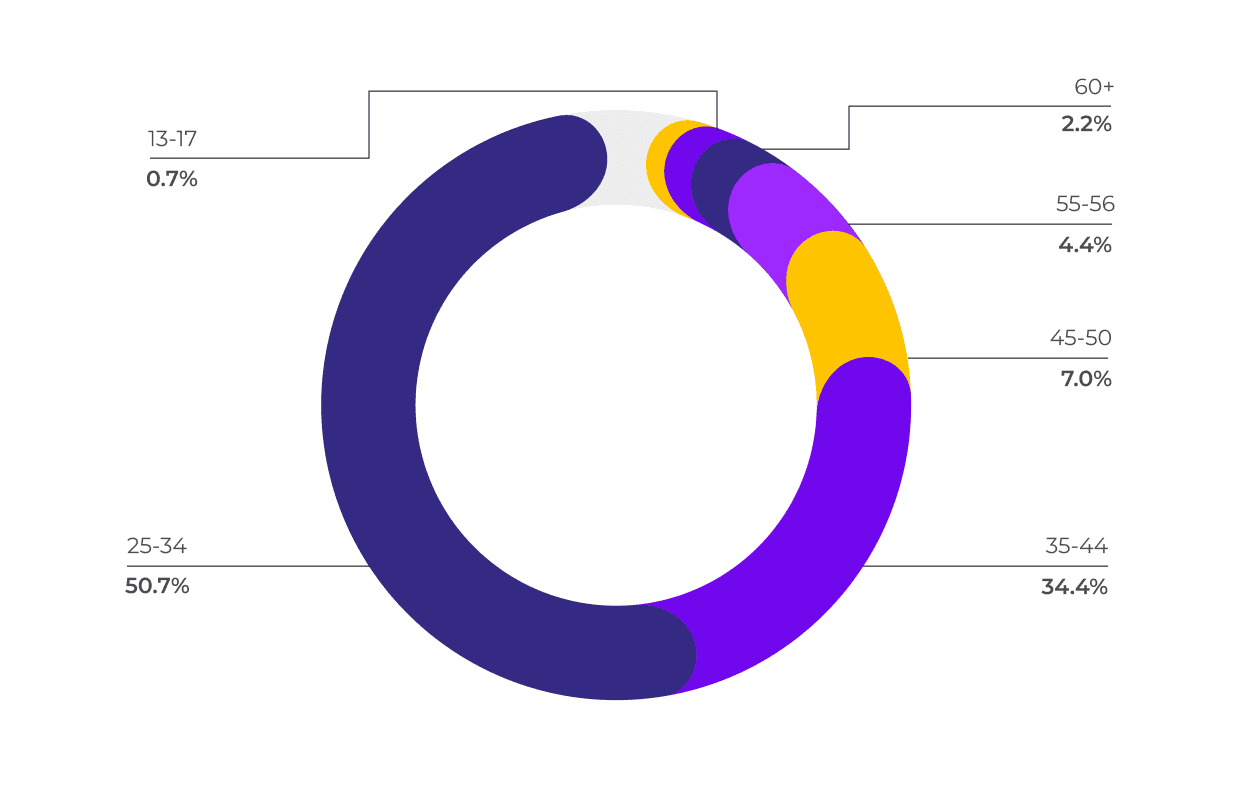
Our A/B Test: Advantage+ App Campaign vs. Manual Campaign
In our test setup, there was only one significant difference, which was the audience. As we could not control the specific target audience in the A+AC at the time of the test (besides location), we tested it against a manual campaign that had age and gender restrictions. For the very same client, we further proceeded with setting up an A/B test on Meta. By doing so, we ensured the audiences would be evenly split and statistically comparable, as informal testing can lead to overlapping audiences and result in a lower reliability for tests. 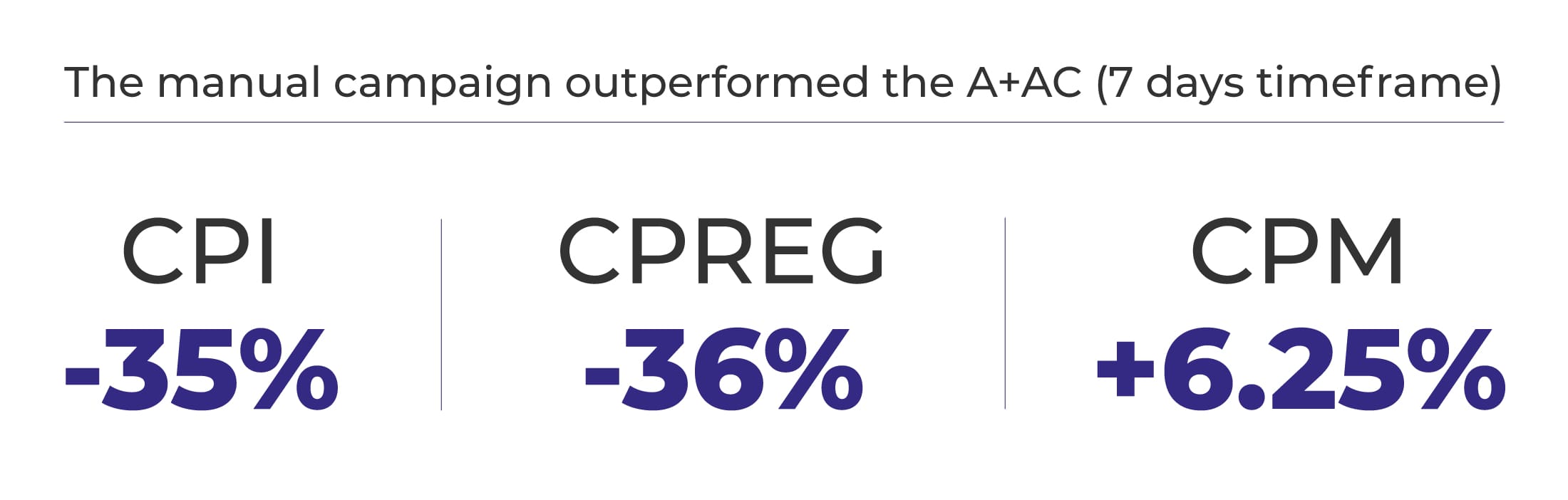
In this Admiral-run A/B test, the manual campaign had a 6.25% higher CPM than the A+AC (see the results table above).
CPI: Cost pr. install. CPREG: Cost pr. registration in-app. CPM: Cost pr. Mille (cost pr. 1.000 impressions).
In terms of experimenting, the hypothesis would be considered a rejection, which did not come as a surprise to the team. Early on, we spotted budget distributions towards irrelevant audience groups. In our Paid Social team, we truly believe in understanding the marketing fundamentals, and this case simply proves it. Nevertheless, we want to underline the importance of always experimenting with new features, targeting options, creatives and overall messaging.
When and how to run incrementality tests and audits
A Meta A/B test like ours compares two campaign setups. It does not tell you how many installs would have happened without the ads at all. For that you need an incrementality test. Three common options:
- Holdout test: keep a random share of your audience from seeing the ads and compare installs, registrations or subscriptions between the two groups.
- Geo test: pause or change spend in some regions and compare them with similar regions where nothing changed. This works when user-level tracking is limited.
- Meta Conversion Lift: Meta’s own holdout study. Meta splits people into a test group who can see your ads and a control group who cannot, and reports the difference as lift. Mobile app events sent via SDKs are a supported data source, the test has no extra cost, and as a guide your account needs a campaign from the past year with at least USD 5,000 in spend and 500 conversions (Meta’s Conversion Lift help page).
Run one before you move a large share of budget into A+AC, and whenever attributed CPI or ROAS in Ads Manager looks better than the growth you see in your own revenue data. Between tests, do a simple audit: Meta’s reporting for A+AC includes age, gender and placement breakdowns, so check them regularly for spend on people who cannot use your product, as we did above. Our guide to incrementality testing for mobile apps covers the setup and how to read the results.
What does our expert say about Advantage+ App Campaigns on Meta?
Should you use Advantage+ App Campaigns: key takeaways
A+AC can undoubtedly be a game-changer, for many advertisers. Its automated, machine-learning-backed features promise efficiency, scalability, and optimized returns. But as with all tools, it’s only as effective as the hands that wield it. The introduction of A+AC means we have a powerful tool that can potentially simplify complex campaigns. But it’s imperative to remember that automated solutions, while efficient, can sometimes miss the nuanced, human touch required for certain target demographics. You should consider A+AC as a part of your toolkit, not the entirety of it. Our experiences with A+AC are just the tip of the iceberg.
What to look for in a subscription app growth partner
Common signs it is time to bring in outside help: CAC has plateaued despite steady spend on Meta and Apple Ads, D7 ROAS has been sliding for several months, or your team cannot produce the volume of video variations that Meta’s creative testing needs. If you are comparing partners, check for:
- Subscription app experience: examples where they reported on trial starts, paid subscribers and LTV, not only installs and CPI.
- A testing habit: a clear answer on how they would test A+AC against manual campaigns and how they measure incrementality.
- Creative volume with evidence: how many new concepts they produce each month, who makes them, and test results behind any claims about AI-generated ads.
- Transparent access: campaigns run in your own ad accounts, with numbers you can check in Meta and in your attribution tool.
- Proof you can verify: published case studies and independent reviews.
Admiral Media was founded in 2019 by Andre Kempe, is headquartered in Dubai, has managed more than EUR 500M in ad spend for 150+ brands and holds a 4.9 rating on Clutch from 48 reviews. Want a second opinion on your A+AC setup or your app’s growth plan? Talk to our team.