




Turn the first answer into accepting terms
Small print under the first question says that choosing an answer accepts the terms.

We went through their sign-up quizzes screen by screen, all the way to the price. Here is what they ask, what they make you agree to and how they price, with the real screens and the tests we would run in your funnel.
A web-to-app funnel is the quiz an app runs on its website to sell you a subscription before you download the app. On 13 October 2026 we went through these quizzes from the first question to the price. This is exactly what we did.
Subscription apps known for selling their plans on a website before the download: fitness, learning, kids, pets and money.
These 23 had a sign-up quiz you can start from the homepage. We answered each one, screen by screen. The other 31 had no quiz there, needed a login, were broken or blocked automated visits.
11 quizzes ended on a price page, and we checked each one by hand against its screenshot. The other 12 stopped first: 2 asked us to create an account, 1 asked us to sign a liability waiver and 9 had a screen our browser could not get past.
The typical funnel showed 35 screens before the price. About 90% of the way through, it asked for an email. Then it offered three plans with a cut-price first period that renews at about 2.5 times the first charge, under a 10-minute countdown.
The pattern is so consistent that Coursiv, Finelo and Liven use identical price points. For growth teams the useful question is not whether to copy it, but which parts of it your own users respond to.
Real screens from Headway, Simple and Liven, captured on 13 October 2026.
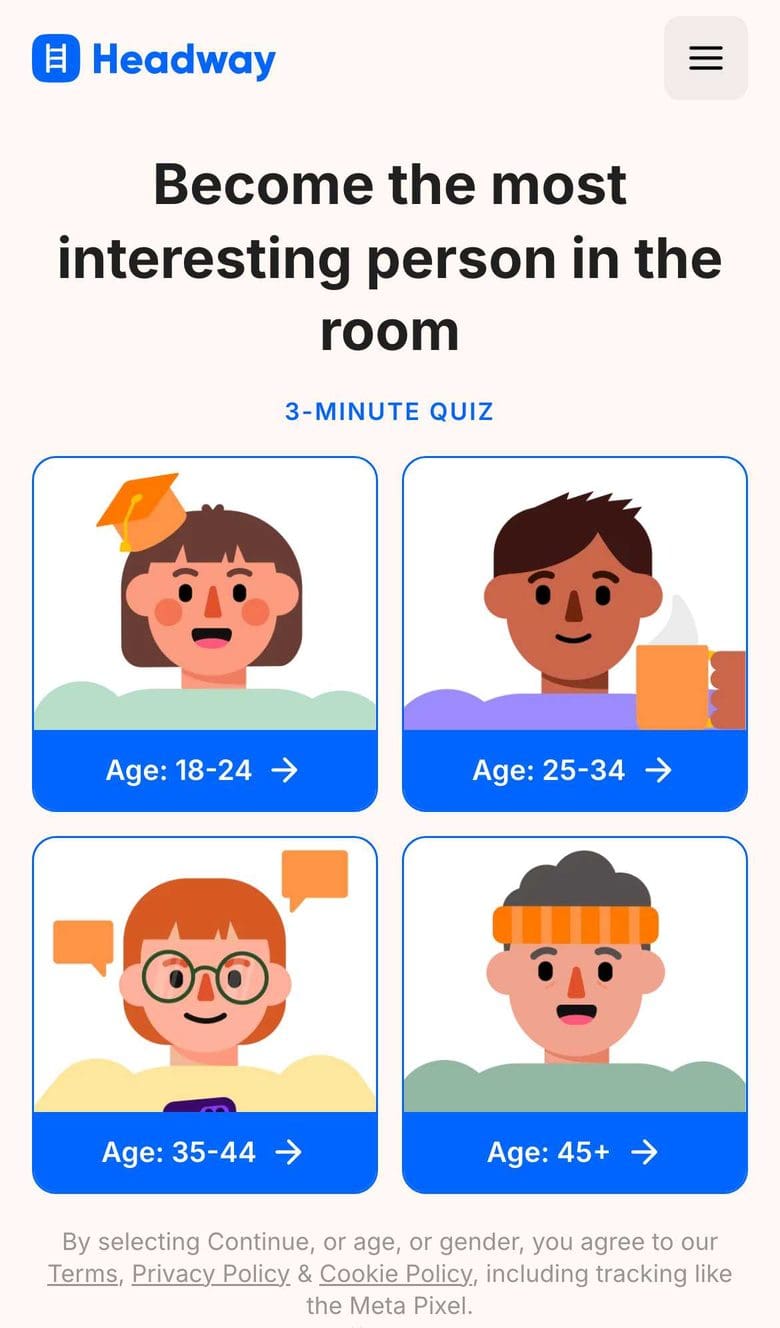
11 of 23 quizzes put the terms under the very first question, so choosing an answer counts as accepting them. On Headway that includes tracking like the Meta Pixel.

Fitness quizzes ask for explicit consent before height and weight. 3 of 23 had a separate health-data checkbox.
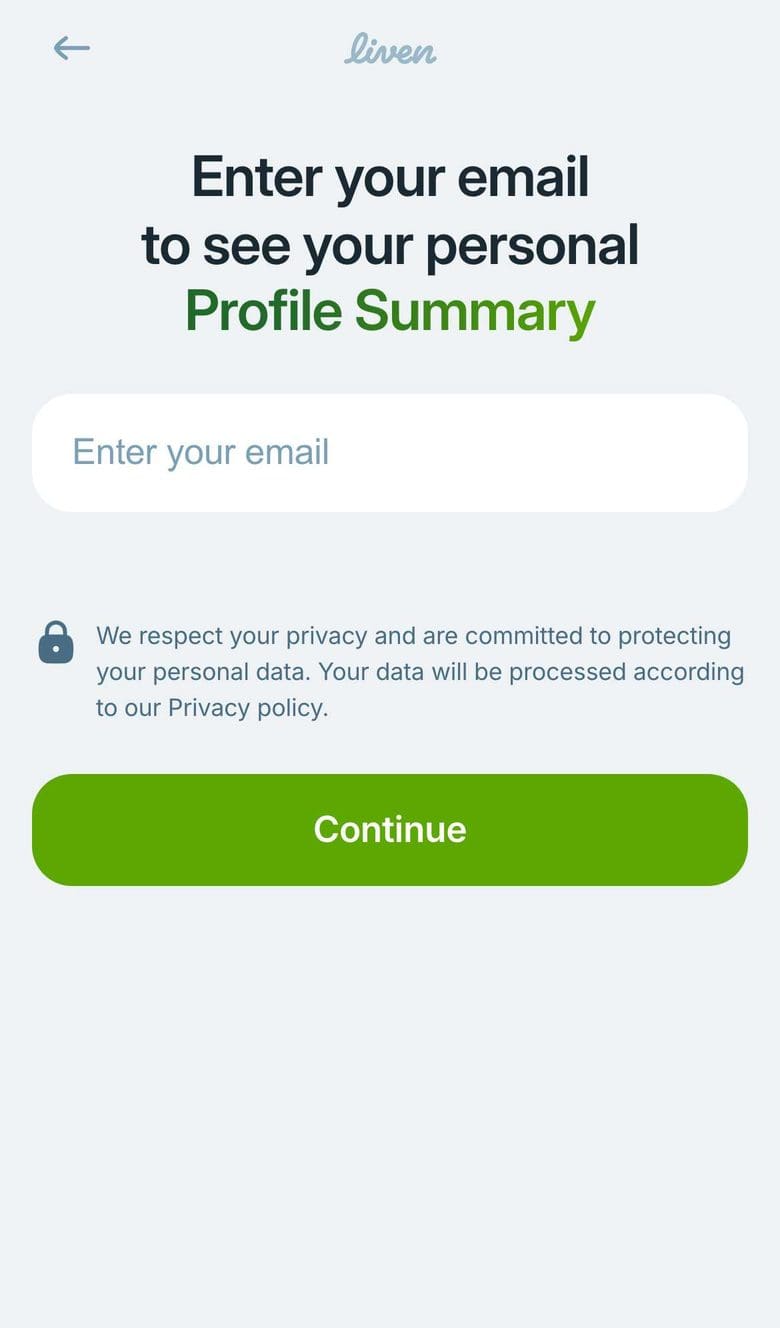
12 of 23 quizzes asked for an email. On the ones that reached a price, the ask came typically 90% of the way through, framed as the key to your results.
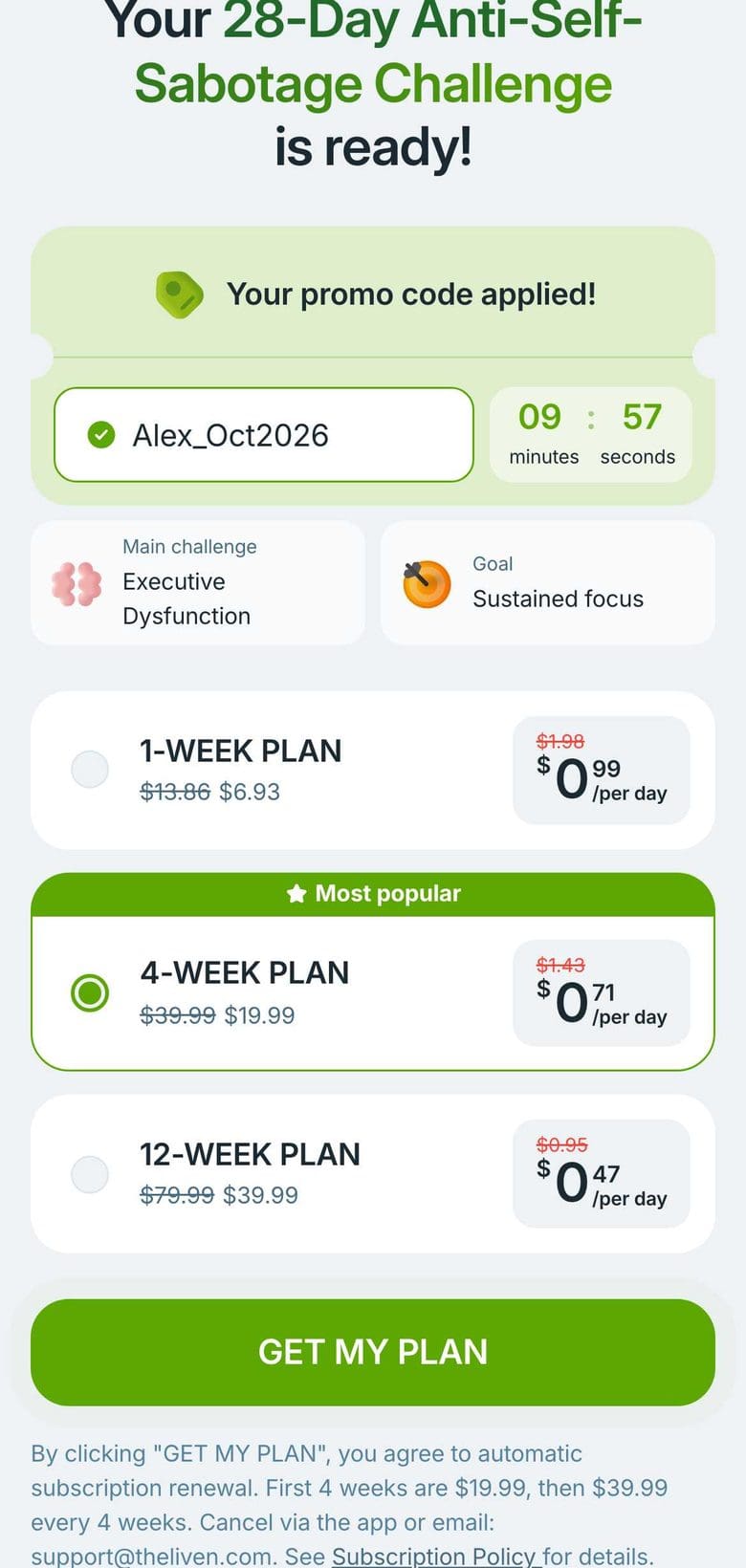
Three plans with the middle one marked Most popular, a promo code built from the first name we typed and a 10-minute countdown.
Each row is one of the 11 quizzes that showed a price, and each dot is one screen. Yellow is where it asked for an email; teal is the price.
Not small apps. Together these 11 apps have more than 1.1 million ratings on the US App Store, and every one is rated 4.3 or higher.
Some screens earn their place. Some just lose buyers.
We map every screen of your funnel, from the first question to the renewal, and show you which ones cost you paying users.
A composite we rebuilt from the 11 price pages, using the most common copy and the plan prices Coursiv, Finelo and Liven share. Tap a number to see how many of the 11 do the same.
Your plan is ready!
30-day money-back guarantee
By clicking Get my plan, I agree to pay $19.99 for my 4-week intro plan. If I do not cancel before it ends, it renews at $39.99 every 4 weeks until I cancel.
BetterMe, Coursiv and Liven build it from the first name typed in the quiz.
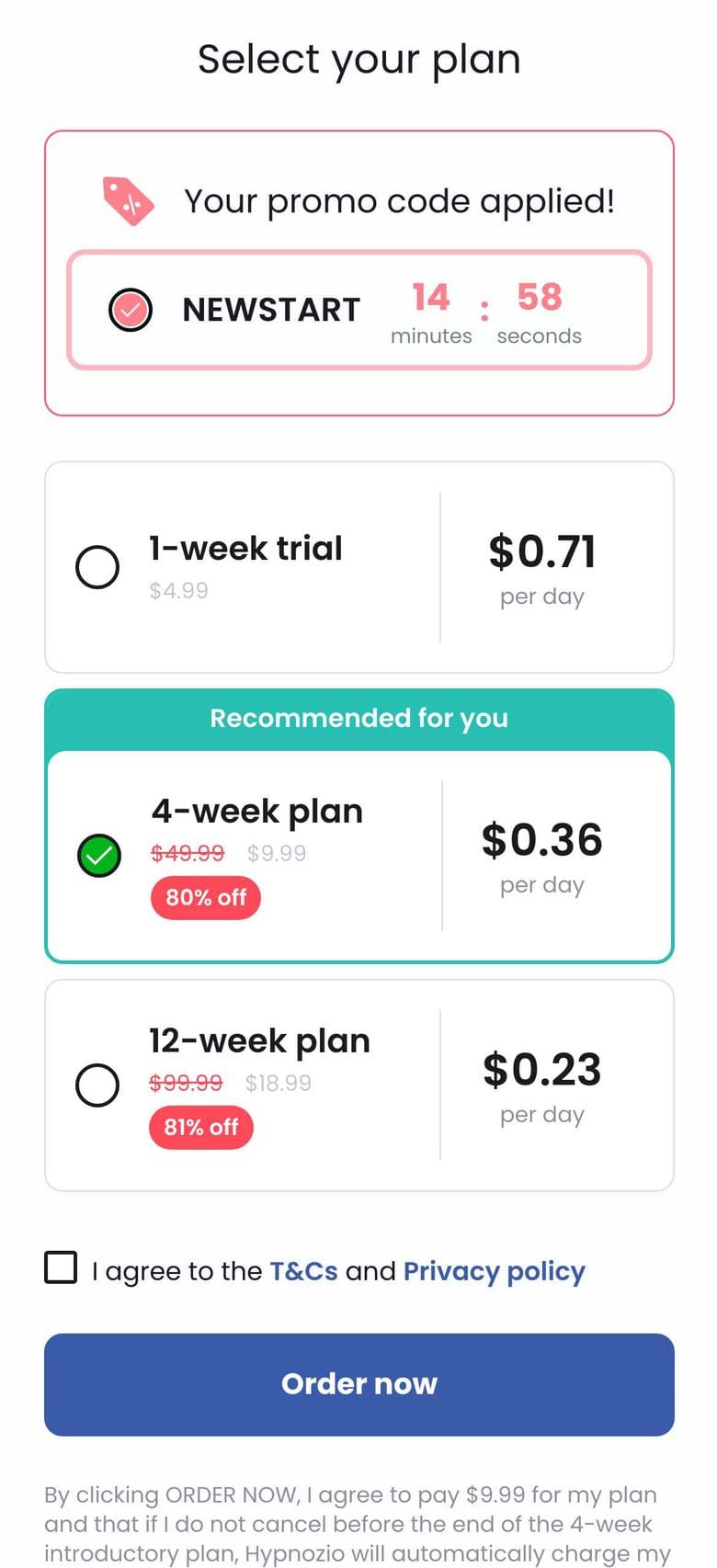
Seven of the eight clocks start at 10:00. Hypnozio's starts at 15:00.
Eight of the nine highlight the middle plan, with a badge such as Most popular or by pre-selecting it.
Typically 60% off the full price. Only Kinedu offers a classic free trial.
Dogo, Headway, Hypnozio and Liven turn the plan into a daily price, such as $0.71 a day.
Liven and Promova offer one outright. BetterMe and Hypnozio attach conditions, such as completing six sessions.
Every page states it, typically at 2.5 times the first charge.
Captured on 13 October 2026. Note how much of the deal lives in the small print under the button.
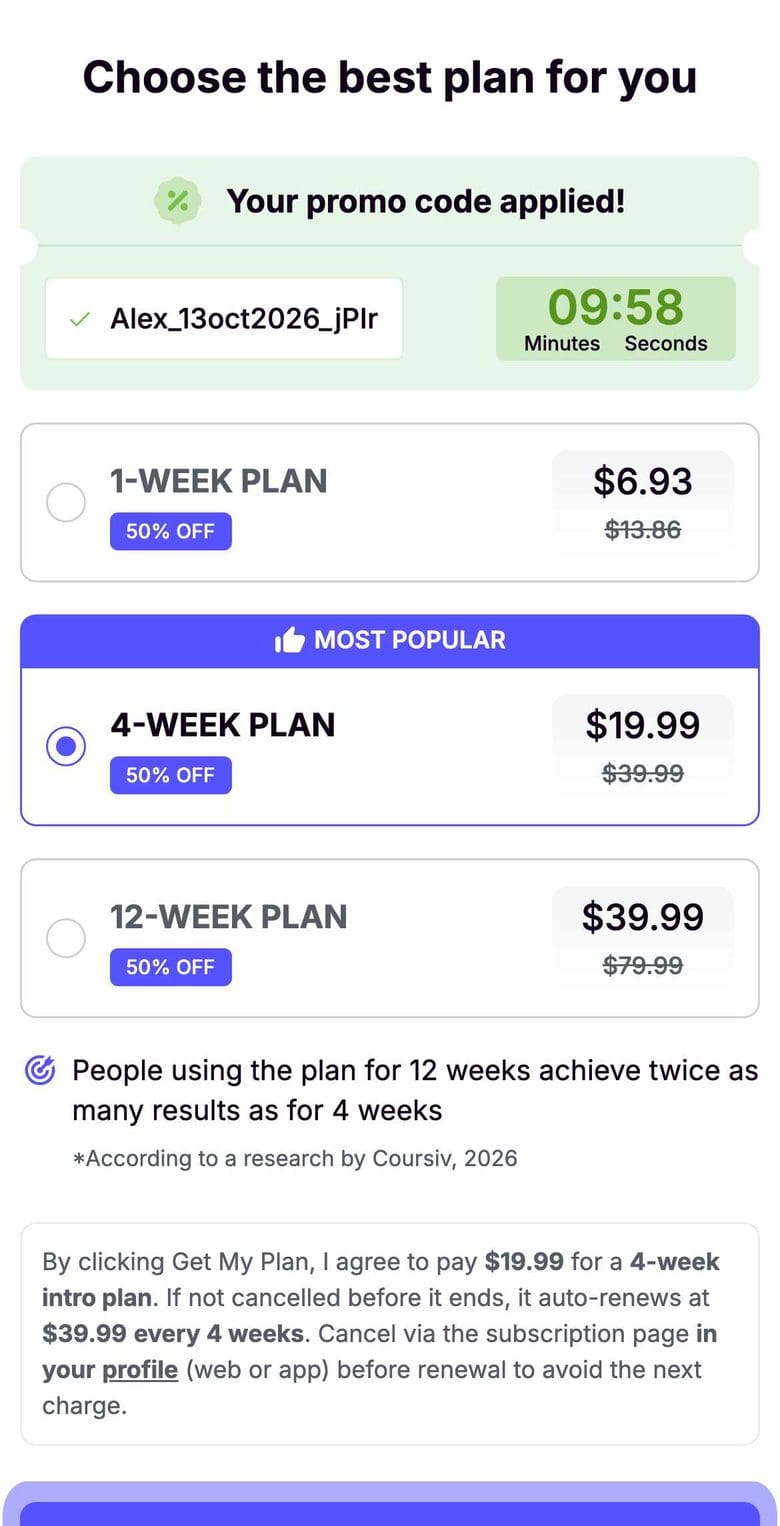
BetterMe, Coursiv, Finelo and Liven all offer a first week for $6.93. Coursiv, Finelo and Liven go further: the same three plans at the same three prices, for AI courses, trading lessons and self-improvement.
Identical prices across very different products suggest a shared template rather than prices tuned to each product. For your own funnel, that makes price one of the first things worth testing.
Your paywall, taken apart like this.
We put your price page next to these 11, line by line, and tell you which change we would test first and why.
Out of all 23 quizzes we answered, including the 12 that stopped before a price.
Small print under the first question says that choosing an answer accepts the terms.
On the quizzes that reached a price, typically 90% of the way through.
A checkbox before height and weight, in BetterMe, MadMuscles and Simple.
Speak and Yoga-Go ask you to sign up to save your plan, instead of showing a price.
Noom showed one at screen 6, after our browser answered Yes to its pregnancy question. We did not sign it.
Enter five things about your own funnel. We compare them with the 11 price pages in this study and suggest what to test first. Nothing you enter leaves this page unless you choose to send it to us.
Move the sliders and pick your answers.
US prices as shown on 13 October 2026, for the plan each page pre-selected or highlighted. Sort the columns, filter by tactic, and open any app to see what stands out on its price page.
| App | ||||
|---|---|---|---|---|
 KineduKids and family4.6★ stars · 7.1k ratings KineduKids and family4.6★ stars · 7.1k ratings
|
8 screens to the priceNo email ask | Free for 7 daysthen $79.99 a year | Free trial | No timer |
Kinedu: The shortest quiz and the only classic free trial in the study: 7 days free, then $79.99 a year, on a single plan. No email ask before the price. | ||||
 DogoPets4.8★ stars · 17k ratings DogoPets4.8★ stars · 17k ratings
|
19 screens to the priceEmail at screen 18 (95% of the way) | $4.99 first weekthen $9.99 every week | 2.0x | 10:00 |
Dogo: Pre-selects the weekly plan ($4.99, then $9.99 a week) while the Most popular badge sits on the quarterly plan. Every plan is also priced per day. | ||||
 PromovaEducation4.6★ stars · 63k ratings PromovaEducation4.6★ stars · 63k ratings
|
19 screens to the priceEmail at screen 17 (89% of the way) | Not capturedthen $69.99 every 12 weeks | Not seen | 10:00 |
Promova: A promo code (LIMITED-SAVE-59) is already added, with a 10-minute timer and a 14-day money-back guarantee. The plan cards had not loaded when we captured the page. | ||||
 HypnozioHealth and fitness4.6★ stars · 13k ratings HypnozioHealth and fitness4.6★ stars · 13k ratings
|
31 screens to the priceEmail at screen 25 (81% of the way) | $9.99 first 4 weeksthen $49.99 every 4 weeks | 5.0x | 15:00 |
Hypnozio: 80% off the recommended 4-week plan, a 15-minute timer, per-day prices, a terms checkbox above the button and a money-back promise tied to completing six sessions. | ||||
 FineloFinance education4.6★ stars · 101k ratings FineloFinance education4.6★ stars · 101k ratings
|
33 screens to the priceEmail at screen 26 (79% of the way) | $19.99 first 4 weeksthen $39.99 every 4 weeks | 2.0x | 10:00 |
Finelo: Uses the same three plans at the same prices as Coursiv and Liven ($6.93, $19.99 and $39.99), with an empty promo code box instead of a code already added. | ||||
 CoursivEducation4.8★ stars · 3.2k ratings CoursivEducation4.8★ stars · 3.2k ratings
|
35 screens to the priceEmail at screen 27 (77% of the way) | $19.99 first 4 weeksthen $39.99 every 4 weeks | 2.0x | 10:00 |
Coursiv: 50% off every plan, a promo code built from the name typed earlier in the quiz and a 10-minute timer. | ||||
 NibbleEducation4.3★ stars · 47k ratings NibbleEducation4.3★ stars · 47k ratings
|
46 screens to the priceEmail at screen 43 (93% of the way) | $19.99 first 3 monthsthen $49.98 every 3 months | 2.5x | No timer |
Nibble: No timer and no badge: the 3-month plan is simply pre-selected, and each plan states its renewal price right next to it. | ||||
 UnimealHealth and fitness4.4★ stars · 13k ratings UnimealHealth and fitness4.4★ stars · 13k ratings
|
48 screens to the priceEmail at screen 46 (96% of the way) | $25.99 first 3 monthsthen $69.99 every 3 months | 2.7x | No timer |
Unimeal: Pre-selects the 3-month plan and writes the renewal price into every plan. No timer and no promo code. | ||||
 LivenHealth and fitness4.4★ stars · 52k ratings LivenHealth and fitness4.4★ stars · 52k ratings
|
55 screens to the priceEmail at screen 35 (64% of the way) | $19.99 first 4 weeksthen $39.99 every 4 weeks | 2.0x | 10:00 |
Liven: A promo code built from the visitor's name, a 10-minute countdown, per-day prices and a 30-day money-back guarantee. | ||||
 BetterMeHealth and fitness4.7★ stars · 714k ratings BetterMeHealth and fitness4.7★ stars · 714k ratings
|
66 screens to the priceEmail at screen 60 (91% of the way) | $15.19 first 4 weeksthen $38.95 every 4 weeks | 2.6x | 10:00 |
BetterMe: A scratch card reveals the 61% discount before the price page. The money-back promise asks you to show you followed the plan. | ||||
 HeadwayEducation4.6★ stars · 117k ratings HeadwayEducation4.6★ stars · 117k ratings
|
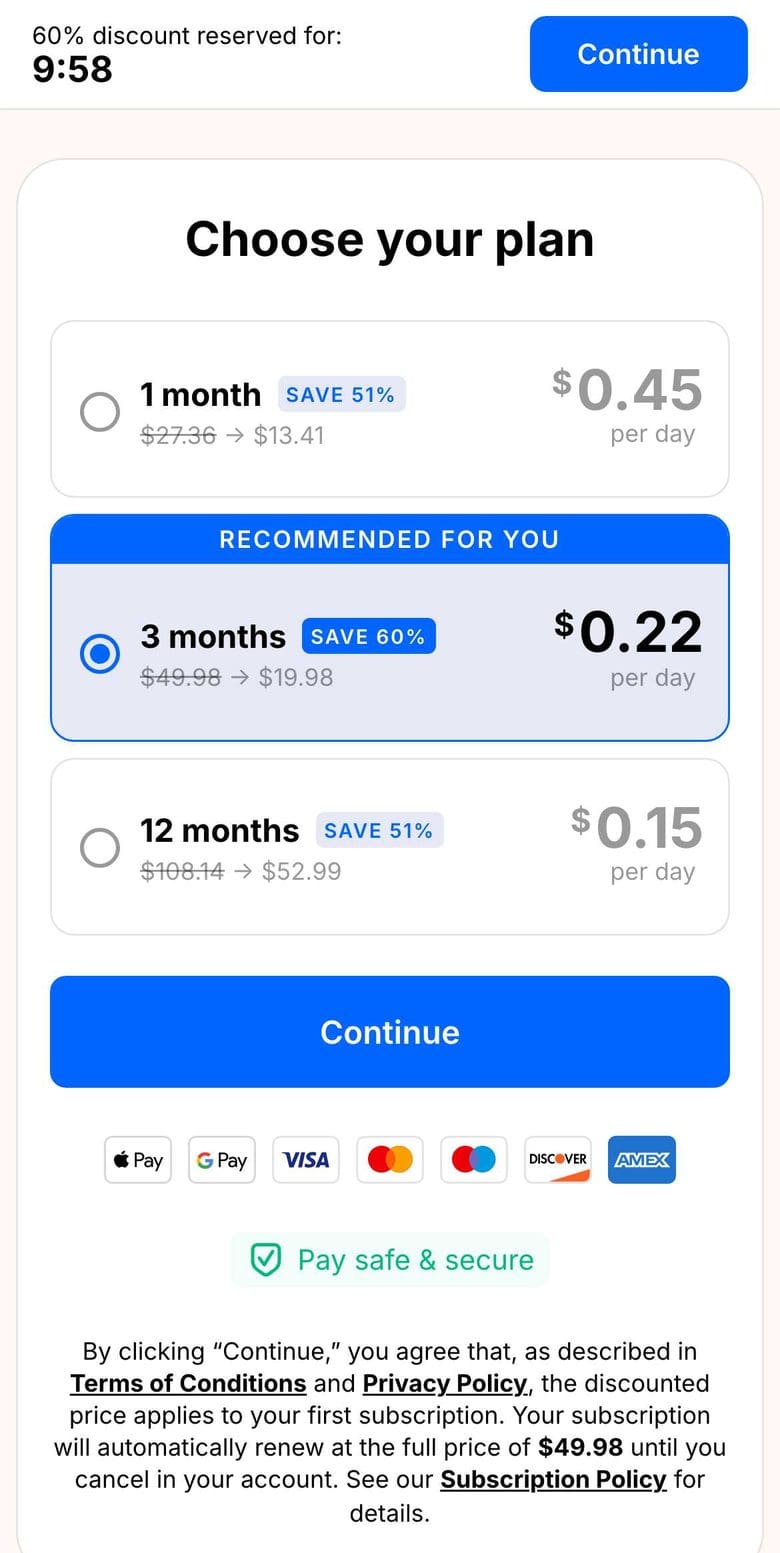
69 screens to the priceEmail at screen 66 (96% of the way) | $19.98 first 3 monthsthen $49.98 every 3 months | 2.5x | 10:00 |
Headway: The longest quiz in the study. 60% off the recommended 3-month plan, priced per day, with the discount reserved for 10 minutes. | ||||
Download the data (CSV) All 23 quizzes and 11 price pages. Free to use with a link to this page.
The number is how many screens each quiz showed before the price, or before it stopped.
A limit of our automated browser, not a fault in the app.
The common pattern tells you what is normal, not what works for your users. These are the tests our CRO team would run first.
The longest funnels are long on purpose: every answer builds commitment and feeds the plan. Find the screens where people leave without adding anything, and cut or merge those first.
Most funnels ask about 90% of the way through, when the visitor already wants the result. Test the position, and judge it on paying users, not on emails collected.
A first period at 50 to 80% off lifts conversion, and renewal can cost 2 to 5 times the first charge. Judge every price test on renewal rate, refunds and revenue per user.
Timers and automatic promo codes are now standard. Test them like any other change, and check every countdown, renewal statement and guarantee against the consumer rules where you sell.
Three plans with the middle one highlighted is the norm. Which plan you push, and how you frame its price, decides revenue per install more than any colour or headline.
Find out what your funnel does to buyers.
Ten points, one line each. Open any of them for the full detail.
54 subscription apps known for selling plans on their website, checked on 13 October 2026. 23 had a sign-up quiz you can start from the homepage. The other 31 were left out: 14 had no quiz there, 9 needed an account or login first, 5 were broken, redirected or for businesses only, and 3 blocked automated visits with a bot check.
An automated Chromium browser set up like an iPhone (iOS 17, English, New York time zone). On every screen it chose the first answer offered, skipping only options for under-18s, and gave the same made-up age, height and weight. It declined optional cookies where it could and stopped at the first price page.
Where a quiz would not go on without it, the browser ticked the terms and health-data boxes, with made-up data, and typed a study email address at email screens. It never created a password, never signed a waiver, never paid and never typed payment details.
11 of the 23 quizzes ended on a price page. The other 12 stopped first: 2 at an account wall, 1 at a liability waiver and 9 at a screen the browser could not get past. Noom's waiver appeared after the browser answered Yes to Noom's pregnancy question, because it always picks the first answer.
We count every distinct screen from the homepage to the price page. If our browser needed several tries on one screen, or a loading screen's percentage ticked up, that screen counts once. Different answers and the apps' own tests can change the count, so each number describes the one path we took.
Recorded as shown, in US dollars, for the plan each page pre-selected or highlighted. Every price page was checked twice, once from its saved text and once against its screenshot. BetterMe showed prices for our location, so we went through it again from a US connection. On 14 October we went through Dogo again to confirm which plan it pre-selects.
Promova's plan cards had not finished loading when we captured its price page, so its plan prices are not recorded and it counts as not seen in the plan-level figures. A second visit was blocked because Promova would not accept the same study email twice.
Rating and number of ratings on the US App Store on 14 October 2026.
None of the apps named in this study is an Admiral Media client, and no app paid for or reviewed its inclusion.
Conversion rates, quizzes that only open from ads, checkout steps after the price page, and how often prices or timers change.
Related research: State of App Store Listings 2026, our study of 1,000 top US App Store listings.
A web-to-app funnel sells a mobile app subscription on the web before the install. A visitor from an ad answers a quiz, gets a personal plan, pays on a web checkout, and then downloads the app and logs in. Apps use it to avoid app store fees and to test pricing faster.
We picked 54 subscription apps known for selling on the web. 23 had a sign-up quiz you can start from the homepage, and we answered all 23 from the first question to the price. 11 ended on a price page: BetterMe, Coursiv, Dogo, Finelo, Headway, Hypnozio, Kinedu, Liven, Nibble, Promova and Unimeal. Together they have more than 1.1 million US App Store ratings. The other 12 stopped first: 2 at an account wall, 1 at a liability waiver and 9 at a screen our browser could not get past.
With an automated browser set up like an iPhone in English with US prices, on 13 October 2026. On every screen it picked the first answer offered, gave the same made-up age, height and weight, and typed a study email address where a quiz asked for one. It stopped at the price page. It never paid, never typed payment details and never created an account.
The typical funnel in our sample showed 35 screens from the homepage to the price: half had more, half had fewer. Kinedu's was the shortest at 8 and Headway's the longest at 69. A screen is one step of the quiz, such as a question, a message or a form. Different answers can change the count a little.
Rarely in our sample. 10 of the 11 price pages charged a discounted first period and then renewed at full price. Only Kinedu offered a classic 7-day free trial.
Yes. You may quote or chart the figures with a link to this page as the source.
We go through your web and app funnel screen by screen, then show you where it loses paying users and what we would test first.